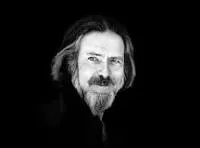
In his lectures, Alan Watts often explores the concept of “as within, so without” through the lens of non-duality, suggesting that the boundary between the “internal” self and the “external” world is a social and linguistic illusion.
He argues that the individual and the universe are inseparable parts of a single process—much like a wave is not separate from the ocean, but is a function of the ocean’s movement.
The Illusion of the “Skin-Encapsulated Ego”
Watts famously critiqued what he called the “skin-encapsulated ego”—the sensation that “I” am a separate center of consciousness trapped inside a bag of skin, peering out at a world that is “not me.” He points out that:
- Transactional Relationship: The organism and the environment are a single “field.” Just as you cannot have a flower without a field to support it, you cannot have a human being without a planet, atmosphere, and sun.
- Mutual Creation: He states, “The environment grows the organism, and the organism creates the environment.” They are two sides of the same coin.
Inner Stillness and Outer Significance
Watts taught that the way we perceive the “without” is a direct reflection of our state “within.” When the inner mind is cluttered with labels and constant chatter, the world appears as a collection of separate, utilitarian objects to be conquered or used.
- Quietening the Turmoil: When inner turmoil quietens, we begin to see “significance” in ordinary things—like peeling paint or sunlight on a road—not because they mean something else, but because they are satisfying as they are.
- Nature as a Mirror: He suggested that if we mistreat our environment, it is because we do not experience it as our own “real body.” By diving deep within to explore the depth of our being, we feel more connected to everything in the world.
Explicit Duality vs. Implicit Unity
Watts often used the principle that every “explicit duality” (like within/without, self/other, or good/evil) is an “implicit unity.”
- The Pole Analogy: Like a magnet with a north and south pole, you cannot have “within” without a “without.” They arise together.
- The Observer and Observed: In the state of realization, the “knower” and the “known” become one “knowing.” You realize you are not a visitor to this world, but an expression of it.
Key Conceptual Pillars
- The Transactional Relationship: Watts argues that the relationship between an organism and its environment is “transactional.” You cannot describe a human being without describing the air they breathe, the temperature they live in, and the food they consume. In this sense, the “within” (your internal biology) and the “without” (the external universe) are a single, continuous field of action.
- The Whirlpool Analogy: To illustrate this, he often uses the metaphor of a whirlpool in a stream. The whirlpool is a recognizable “thing,” but it has no substance of its own; it is simply a pattern of the stream’s behavior. Similarly, you are a “pattern” of the universe’s behavior—a place where the whole cosmos is “peopling.”
- The Illusion of the Skin Boundary: He challenges the common-sense idea that you stop at your skin. Your skin is not a wall that shuts the world out; it is a bridge. It is a vibrating membrane through which the “external” world flows into you and through you. Without the “without,” there is no “within” to speak of.
- Ecological Awareness: Watts believes that our current ecological crisis stems from the hallucination that we are separate from nature. He suggests that if we truly realized that the environment is our “external body,” we would treat it with the same care and respect we give our “internal body.”