
Yoga Nidra, often called “yogic sleep,” is far more than just a nap with a soundtrack. While you remain physically still, your brain undergoes a highly specific sequence of shifts that bridge the gap between conscious thought and the subconscious.
Here is the neurobiological breakdown of what happens when you step onto the mat.
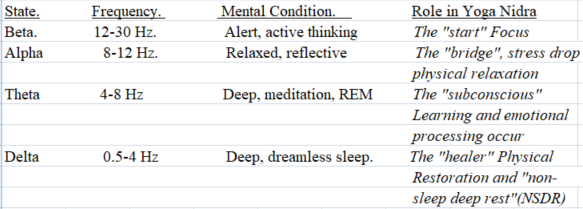
1. The Shift in Brain Wave States
The “magic” of Yoga Nidra lies in its ability to take the brain through a spectrum of frequencies without the practitioner actually falling into a deep, unconscious sleep.
2. Down-regulating the Nervous System
Yoga Nidra is a powerful tool for modulating the Autonomic Nervous System (ANS).
- Vagal Tone: The practice stimulates the Vagus Nerve, which acts as the brake pedal for your heart rate and breathing.
- Parasympathetic Dominance: By moving away from the “Fight or Flight” (Sympathetic) response, the body enters “Rest and Digest.” This lowers cortisol levels and allows the body to prioritize cellular repair.
3. The “Biological Reset” (Dopamine & Glutamate)
A landmark study using PET scans showed that during Yoga Nidra, there is a 65% increase in dopamine release in the ventral striatum.
- This isn’t the “addictive” dopamine spike you get from scrolling social media.
- Instead, it’s a stabilizing release that regulates mood and helps “reset” the brain’s reward system.
- The practice also helps balance Glutamate and GABA, the brain’s primary excitatory and inhibitory neurotransmitters, leading to a profound sense of mental stillness.
4. The Sensory Withdrawal (Pratyahara)
During the “Body Scan” phase, you systematically rotate your awareness through different body parts. Neurobiologically, this correlates to the Sensory Homunculus (the map of the body in the brain’s cortex).
By focusing intensely on each part and then letting it go, you effectively “isolate” the motor and sensory cortex, leading to a state of sensory withdrawal that prevents the brain from being distracted by external stimuli.
Why it feels like “4 hours of sleep in 45 minutes”
While Yoga Nidra isn’t a 1:1 replacement for biological sleep, it provides Non-Sleep Deep Rest (NSDR). By staying in the Delta and Theta states while conscious, the brain can clear out metabolic waste (via the glymphatic system) much faster than it does during a stressful or interrupted night of sleep
Research Studies
1. The 65% Dopamine Increase
The specific statistic regarding dopamine release during Yoga Nidra comes from a landmark study often cited by neuroscientists like Dr. Andrew Huberman:
- Study: Kjaer, T. W., Bertelsen, C., Piccini, P., Brooks, D., Alving, J., & Lou, H. C. (2002). * Journal: Cognitive Brain Research. * Title: “Increased dopamine tone during meditation-induced change of consciousness.”
- Key Finding: Using PET scans, researchers found a significant increase in endogenous dopamine release in the ventral striatum during Yoga Nidra, correlating with a reduction in “readiness for action.”
2. Brain Wave Transitions (Alpha, Theta, Delta)
The mapping of Yoga Nidra to specific EEG patterns is supported by decades of meditation research, notably:
- Resource: Kumar, K. (2008). “Yoga Nidra and its impact on EEG patterns.”
- Source: Indian Journal of Physiology and Pharmacology.
- Key Finding: Documentation of the “Alpha-Theta” crossover, where practitioners maintain awareness despite the presence of deep-sleep Delta waves.
- Additional Resource: Stancák, A., et al. (1991). “EEG changes during Yoga Nidra.”
3. The Sensory Homunculus & Body Scanning
The theory that rotating awareness through body parts “deactivates” specific cortical regions is based on the Penfield Homunculus model of the brain:
- Resource: Saraswati, S. S. (1998). Yoga Nidra. Yoga Publications Trust.
- Context: While this is a foundational text of the practice, it bridges the gap between ancient Tantra and modern neurology by explaining how the “rotation of consciousness” systematically stimulates the primary motor and sensory cortex.
4. NSDR (Non-Sleep Deep Rest) & Stress Reduction
The term “NSDR” was popularized by Dr. Andrew Huberman (Stanford School of Medicine) to describe Yoga Nidra in a secular, clinical context:
- Resource: Huberman Lab Podcast (Episode 69). “Master Your Sleep & Be More Alert with Science-Based Tools.”
- Study Link: Ferreira-Vorkapic, C., et al. (2018). “The Impact of Yoga Nidra on Anxiety in Patients with Menstrual Disorders.” International Journal of Yoga. (This study provides the data on cortisol reduction and Vagal tone improvement).
5. Glymphatic System & “Reset” Theory
The idea that Yoga Nidra mimics the restorative properties of sleep (specifically metabolic waste clearance) is supported by:
- Study: Xie, L., et al. (2013). “Sleep drives metabolite clearance from the adult brain.” Science.
- Connection: Yoga Nidra practitioners utilize this “Delta-state” physiology to achieve similar restorative effects as those found in the deep stages of NREM sleep.